44
Making
a nest
Many birds lay their eggs in a warm cup of material called a nest.
To make a cup-shaped nest, the bird pushes the materials it has
gathered loosely into place. It then sits in the centre of the nest
and begins to turn round and round, pushing downwards and
outwards with its breast. This circular movement, which gives
the inside of the nest its shape, is shared by all birds.
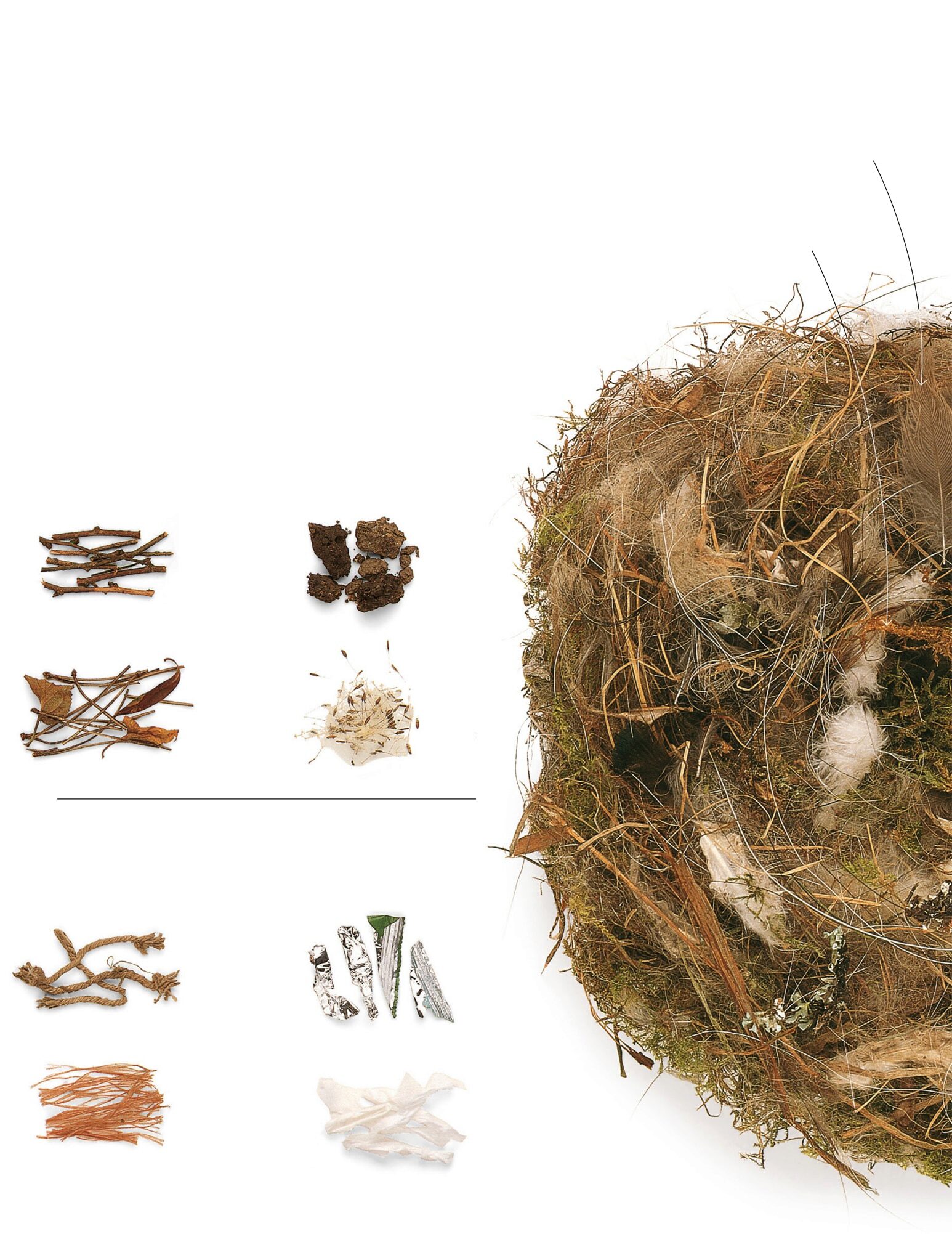
Natural materials
Most hedgerow and woodland birds use sticks to build
their nests and line them with feathers, seed heads, or
animal fur. House martins and some swallows make their
nests entirely from mud.
Mud
Mixed with
saliva to
form a
paste.
Seed
heads
Used in
the nest
lining for
insulation.
Leaves and
needles
Used for
the inside
of many
cup nests.
Twigs
and sticks
Main structural
material in
larger nests.
Human-made materials
Anything that can be carried away may end
up in a bird’s nest – even metal and plastic.
String
Small lengths
are used in
many nests.
Metal foil
Often
collected by
crows and
magpies.
Plastic twine
A favourite with
birds nesting
on farmland.
Paper
Found in the
nests of many
city birds.
Feathers for
insulation
Dry grass seed
heads to form
structure